The Wāzza: The Gourd Trumpet of the Blue Nile
The Sound of Community: Ritual and Resonance in Sudan’s Gourd Orchestras
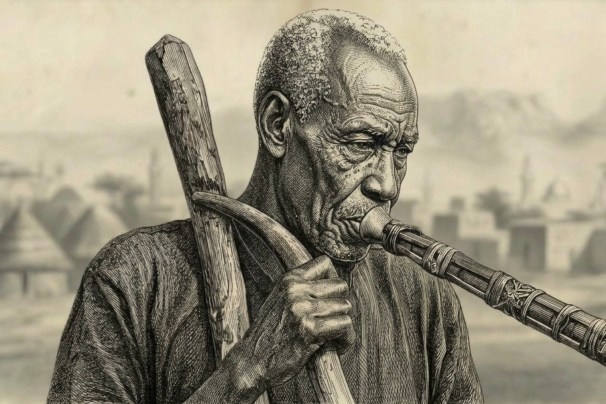
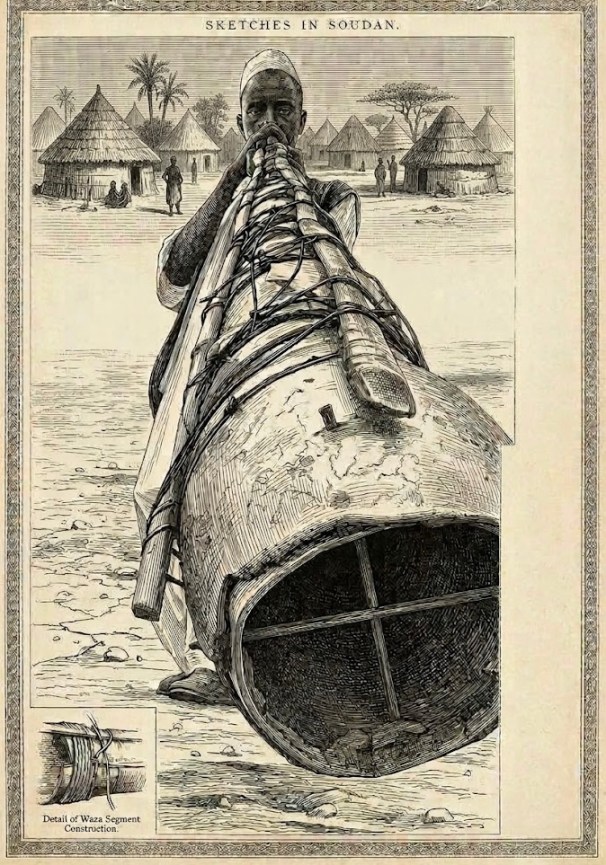
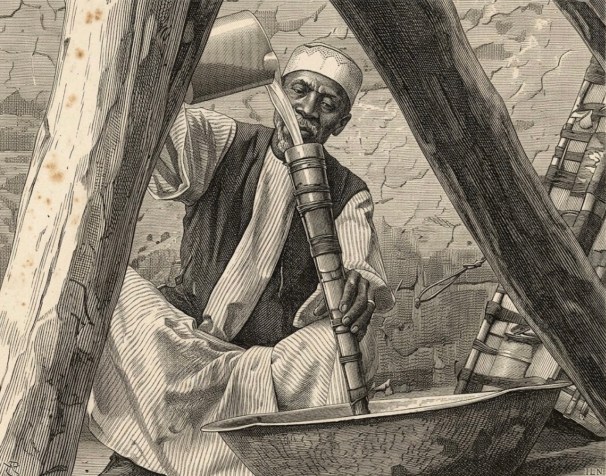
Above, an AI-generated etching of a Blue Nile musician playing the gourd trumpet or wāzza (أبواق الوازا) so emblematic of the region. Playing the wāzza demands strength, resilience and no small helping of stamina. This single pitch wind instrument requires similar skills to those needed for the western trumpet or trombone; with sound created from the vibration of the musician’s compressed lips over the circular edge of the blowing aperture. Playing the wāzza is also highly communal. As most trumpets produce only one note, mini orchestras or ensembles of players, are intrinsic to both its musical composition and appreciation. Although playing the wāzza is reserved for men, the dancing and song that always accompany a trumpet concert are open to all.
In addition to the trumpet, the player above carries over his right shoulder the V-shaped wooden branch or bulu and its percussion mallet or pale, tapped rhythmically to accompany the wāzza. This key complementary “percussive aspect adds depth to its musical versatility, allowing it to contribute to African polyrhythmic patterns during performance.” (Organology)
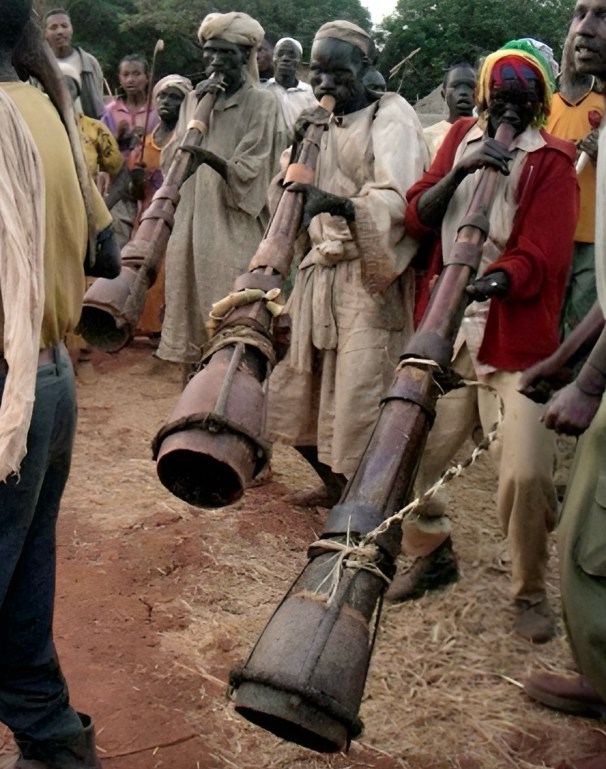
Above, a wāzza ensemble or jooqa in full joyous swing, photograph Wikicommons. The longest intruments of the ensemble can reach more two meters. See and hear the trumpets being played here (Al-Arabiya clip).
As the ongoing conflict in Sudan threatens to undermine the fabric of communal life, music has come to embody defiance in the face of tragedy and cultural resilience in the face of indiscriminate destruction. For more on the challenges facing Sudanese musicians, see Reuters’ report Sudan war cripples musicians’ livelihoods as instruments grow scarce and costly.
The Sound of Community: Ritual and Resonance in Sudan’s Gourd Orchestras
The Sound of Community
From Harvest to Horn The Gourd Orchestra
Video Links
The Sound of Community
From the collection Waza, Bal Naggaro, Abangaran – Die Musik Der Berta Am Blauen Nil – Music Of The Berta From The Blue Nile. Released in 2003 by Wergo, Germany. Recorded by Arthur Simon in November 1982 and September-November 1983, in the Blue Nile Province of Sudan.
Beautiful or discordant? As music specialist Dafallah Al-Hajj, cultural champion of the wāzza, reminds us, perceptions are borne out of cultural context.
For the peoples of the southern Blue Nile region of Sudan, the heralding of harvest time with the gourd trumpet or wāzza is an enduring testimony to a fiercely distinctive musical heritage. As Sudanese music expert Amir Al-Nour, speaking to Blue Nile TV in the early 2000s, explains, it is a heritage still joyfully celebrated by Berta villagers of all ages and social status; “If you are not playing, then you are dancing or singing.” The orchestral trumpet ensembles or jooqa and their accompanying dancers and singers, have been credited with helping to forge and maintain flourishing communal and ecological networks among peoples whose homes straddle what are now the Sudan and Ethiopia borders. The wāzza‘s capacity for binding communities together was evident most recently in July 2022, when, after clashes killing more than 120 people in Blue Nile State, the wāzza was played “to celebrate a halt in the violence” (RFI).
Although often attributed to the Funj Sultanate, Amir Al-Nour is quick to stress that the wāzza is now believed to pre-date the Funj era and to be more closely associated with many tribes indigenous to the Blue Nile region and particularly prevalent among the Berta, the Gamuz and the Barūn. The very different musical landscapes of the Funj and the Berta, the prevalence of wind instruments among the latter (scroll down to see more examples documented by pioneering Sudanese musicologist Ali Al-Daw), would also seem to add weight to this position. The Berta underwent mass conversion to Islam in the 19th century under Funj leadership, and while their musical heritage became overlaid with Islamic sacred music tradition, they remained fiercely loyal to their highly communal “indigenous secular music.” (Embracing Nature for Cultural Continuity: Waza Trumpets and the Musical Tradition of the Berta, Timkehet Teffera). The wāzza is also said to have spread to Darfur and Kordofan, though the gourd trumpets found there may well also be indigenous. Opinion differs on how old the wāzza is, with estimates ranging from just over a century to five centuries of enduring tradition.
Many intriguing theories have been put forward for the origin of the wāzza. Amir Al-Nour fondly recalls folk wisdom arguing the wāzza evolved from the simple bamboo pipe or, more colourfully that it was invented by a young child seeking to imitate the calls of the wild creatures – lions and puma, of his woodland home.
Today the trumpet is played at numerous ceremonies and celebrations, most notably at weddings and harvest times. It takes pride of place both in annual music festivals and in mourning ceremonies upon the death of a clan leader. Once, it is claimed, the wāzza was a symbol of regal authority, sounded in royal Berta courts at the behest of Berta rulers at court-only functions. In this way, the wāzza is said to echo practices common in other African courts, such as those of Uganda, South Sudan and Ethiopia (Timkehet Teffera, as above). It has also been suggested that it served as a herald for national mobilisation or for the summoning of tribe members. It is interesting to note reports that Sudanese president, Jaafar Al-Numeiri ordered a trumpet fanfare in honour of his first visit to Al-Damazin – an event, it is claimed, that led to the wāzza’s subsequent popular role in honouring visiting dignitaries.
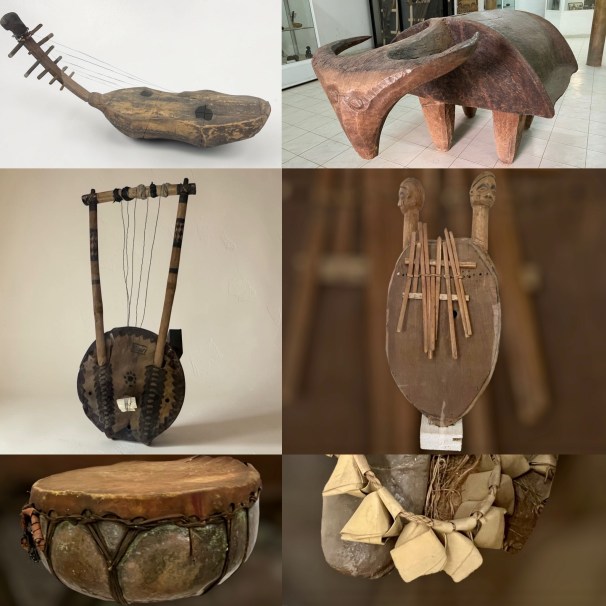
Above right, Sudanese instruments displayed at Sudan’s Ethnographic Museum, Khartoum, pre-war. For more on Sudan’s immensely diverse musical heritage, see The Contrapuntal: Dafallah Al-Haj A Titan of Sudan’s Musical Heritage.
Above, an AI-generated etching of a gourd trumpet ensemble.
Whatever its origins, the gourd trumpet of the Blue Nile is still resonant with ritual and authority. It is never played in the rainy season for fear of evil spirits causing a harvest to fail and crops to wither and die, although more pragmatic interpretations of this strict taboo hold it might have more to do with not distracting farmers from their arduous work in the fields at this time. Sets of wāzza are set aside in autumn, preserved in the homes of village elders, clan or religious leaders or instrument maker guardians, where hut smoke can protect the delicate structures from termites Amir Al-Nour). Before the trumpets are played again, solemn blessing rituals must be observed, led by the Babarush or Sheikh Al-Wāzza. Blood from a sacrificed sheep, goat or hen is sprinkled from palm fibre twigs by the Sheikh’s wife, anointing the hut and instruments, together with sprayings of sesame and sorghum (Amir Al-Nour).
The trumpet craftsman enjoys valued status in the community and acts as guardian of the delicate ecosystem the community’s musical identity depends on, immediately replacing with a new plant any gourd used. Playing the wāzza demands mastery of skills passed down with pride from generation to generation. As Youssef Ismail, instrument maker and player interviewed in 2022, recalls, “We learned this craft from our parents……We taught our children how to make and play the instrument. They will keep it alive after we are gone.”
From Harvest to Horn
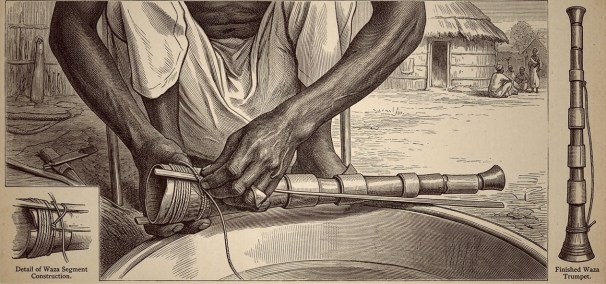
Securing the many gourd segments that make up the wāzza. Contrary to some commentaries, Amir Al-Nour stresses that the wāzza is never made from animal horn.
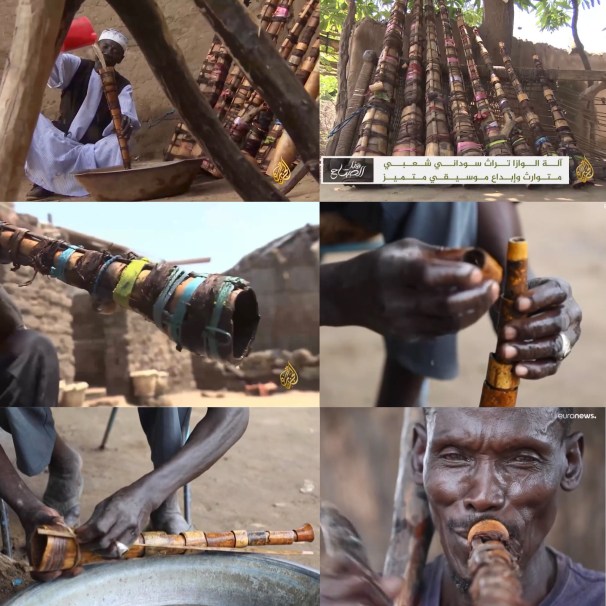
Gourd seeds are planted upon the arrival of the first light rains or rashsha of the rainy season. The seedlings are supported by sticks and later the climbing vines are guided onto canopy trellises where they fruit. Amir Al-Nour explains that cultivators are given special instructions on the type of gourd to be planted: a long, cylindrical variety of bottle gourd that can reach a meter in length, known locally as ago, sufficiently hardy and plentiful to be crafted into sets of ten to twelve trumpets. Each trumpet consists of three to six or more interlocking gourd segments, fitting together to form a telescope-like structure. Natural glue from local tree species, known as adegella, or honey wax is used to secure junctures and thin bamboo sticks are inserted crosswise to support the inside walls of the trumpet and funnel-shaped mouthpiece, also made of gourd. Trumpets more than half a meter are also supported by three or more thin strips of bamboo along their length, fastened with string from tree bark or similar plants (source: Timkehet Teffera, as above).
As the wāzza produces only a single note when played, trumpets are often made together in a set in one go, with experienced craftsmen starting with the shortest trumpet, known as the wāzza alu, determining its sound. He then goes on to make the next larger, adjusting the length relative to the first and tuning its pitch accordingly. The trumpets are tested separately and in sets so that slight adjustments can be made. As with many African instruments, measurements are taken from existing sets, rather than from fixed standard measurements (Timkehet Teffera). This may account for the remarkable continuity of sound over generations of trumpet making and Amir Al-Nour reminds us that trumpets that fail to deliver the correct note are destroyed. The first eight trumpets of the ensemble are generally composed for three to four gourd segments, while the ninth and tenth trumpets may have six or more segments varying in length. Trumpet length may vary from forty-five centimeters to two meters, with mouthpiece diameters of four to six centimeters. Trumpets are named according to their length and resulting pitch within the ensemble, from the shortest to the longes, with names varying from village to village. See Timkehet Teffera for a fascinating breakdown of trumpet names and detailed pitch scales, whose range extends over two octaves.
For more in-depth discussion of the gourd trumpet, see Amir Al-Nour’s interview in آلة الوازا – مساء جديد – قناة النيل الازرق Blue Nile TV (Arabic only). The expert has recently undertaken a doctorate in the trumpet’s orchestral qualities.
The wāzza’s voice can only come alive after its surfaces both inside and out, have been wetted with water. This helps to seal up any fissures or breaks in seals and ensure ease of playing, as well as to produce the required resonance. The trumpet must remain moist during playing. The instrument is susceptible to water and insect damage and so must be renewed every year, with the same grower and craftsman often undertaking the task of dissembling and renewing segments
Above right, stills from هذا الصباح-“لوازا” آلة موسيقية سودانية شعبية, شاهد: على أنغام آلة الوازا يحصد السودانيون الذرة and آلة “الوازا” في السودان reports dedicated to the making and playing of the wāzza.
The Gourd Orchestra
When the trumpets have been thoroughly wetted, each musician selects his favourite instrument and after testing its sound, both individually and in the group, the ensemble proceeds to the performance venue (Timkehet Teffera, as above). Quoting other researchers, Teffera notes that Berta ensembles usually consist of ten to twelve instruments, their composition “depending on the sound production, accentuation and aesthetic preferences of experienced musicians”. Ensemble members’ collaboration often spans decades playing together, generating a unique ensemble sound and tone. Players interviewed (see below) speak of fellow members as beloved brothers.
The use of more than four or five trumpets, Teffera explains, may contribute to the amplification of certain pitches. During performances, the first five trumpets are held up in front of the body while the much longer trumpets seven to ten rest on the ground. Some accounts note that children sometimes help to support the longer trumpets. The musician hold these in both hands “with all his power”. “Musicians often support the embouchure with the right hand and the middle of the tube with the left hand.” (Timkehet Teffera as above). The player of the shortest wāzza is considered the maestro or conductor of the ensemble (Amir Al-Nour).
Each player contributes a single tone to create a polyphonic texture, employing the hocket technique—a method where individual notes interlock to form a cohesive melody. This technique demands precise timing and coordination among players, as each musician inserts their pitch at the appropriate moment within the rhythmic structure. The result is a rich, polyrhythmic soundscape characteristic of African musical traditions. (Organology)
The first five wāzza players may simultaneously play the bulu, a fork-shaped wooden branch, tapped with a mallet or pale, sometimes made of animal horn. Musicians interviewed also explain that the pale may be used to signal to players that they have made a mistake or that the time has come to stop playing. Gourd rattles, used to accentuate rhythm, are also common accompaniments, usually held in the right hand. The trumpets are also sometimes accompanied by the transverse horn or angari, a goat’s horn thirty-five centimeters in length, “often decorated by fringes of animal hair, shells and colourful beads” (Timkehet Teffera) and occasionally flutes.
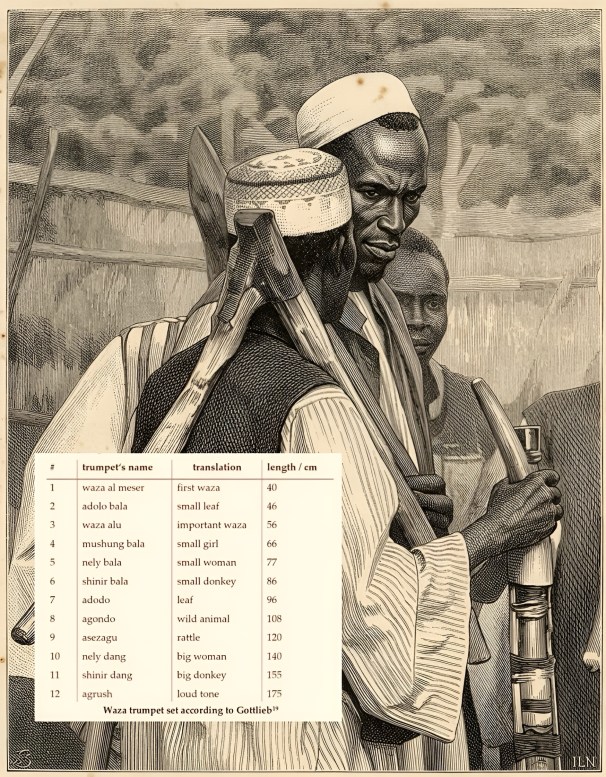
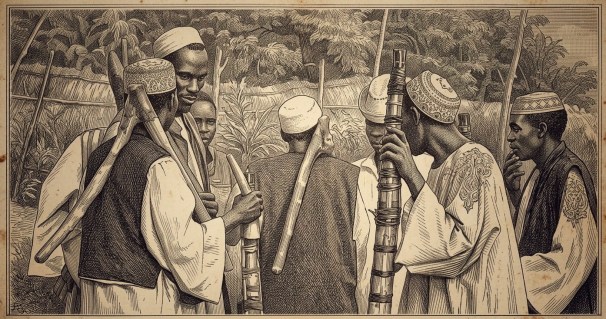
Above, an AI-generated etching of wāzza players, with insert from Timkehet Teffera’s paper cited above, listing the names of trumpets from shortest to longest.
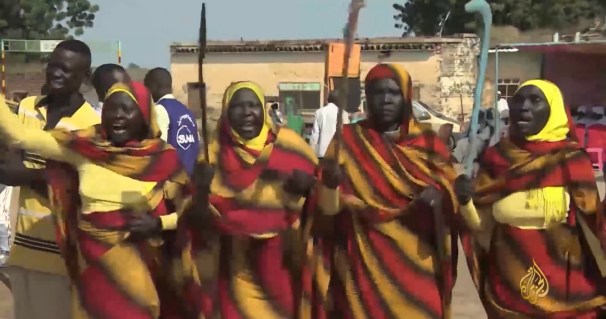
There is a complex choreography to the trumpet medleys and their accompanying songs and dances. The “director” of singing is expected to know the whole repertoire of songs, passed down unchanged in many cases over generations. Traditional Berta songs often employ a call-response mode between the lead singer and chorus but songs performed in unison, short verses repeated, as well as spontaneous lyrics are also performed (Timkehet Teffera). The singing and dancing groups, composed of women, men and often children, encircle the musicians as they perform. There is a careful and sensitive interplay between players, dancers and vocalists, creating an intense musical drama, full of energy and force in its own right.
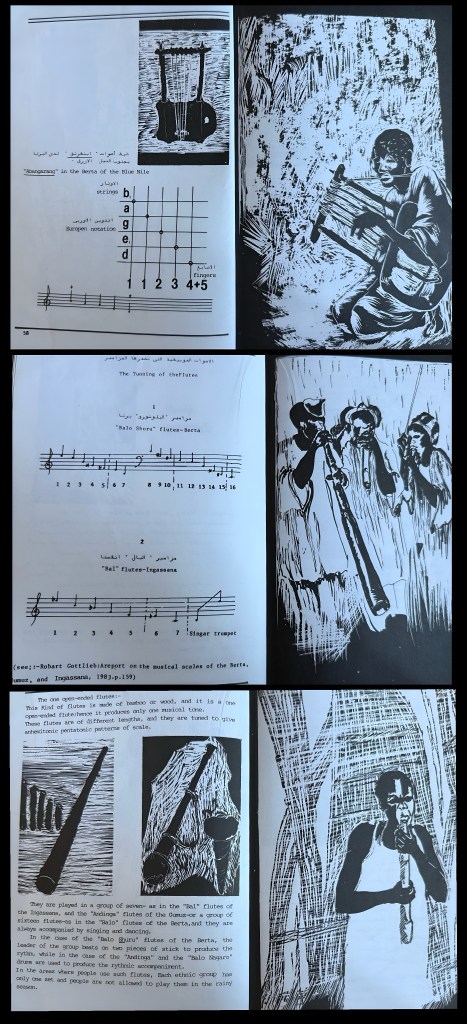
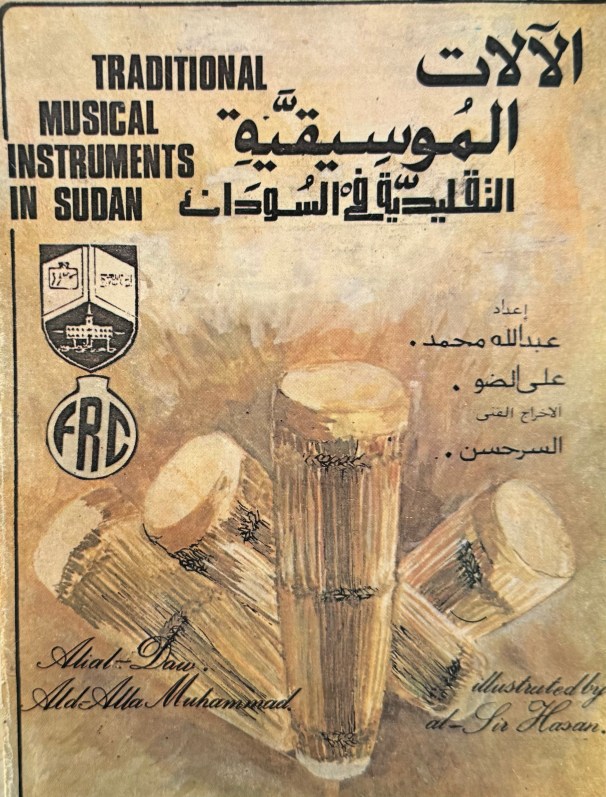
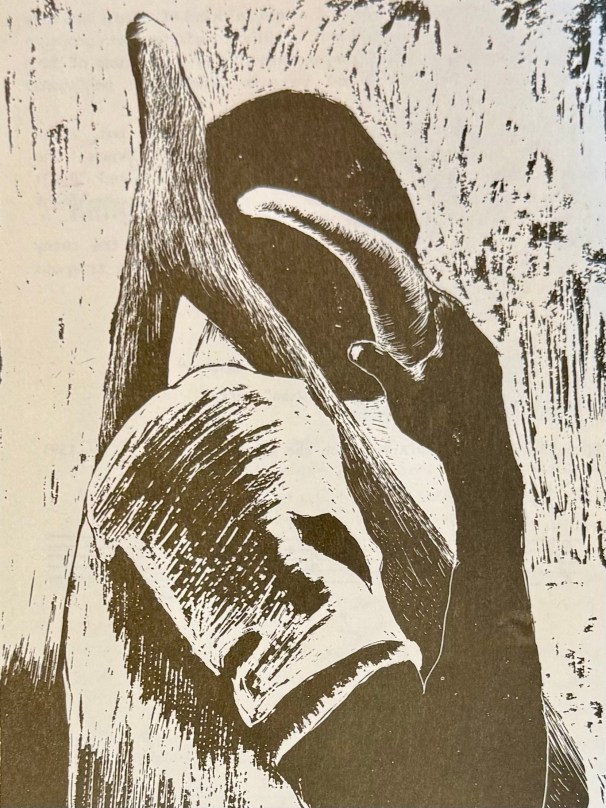
Above top left, illustration of a wāzza player with his bulu pale, from Traditional Musical Instruments in Sudan by Abdullah Muhammad Ali Al Daw, illustrated by Al-Sir Hasan, University of Khartoum 1985. See more on this remarkable researcher in Andariya’s Dr. Ali Al Daw: Music as Heritage. Above right, a still from Al Jazeera هذا الصباح-“لوازا” آلة موسيقية سودانية شعبية – automatic English subtitles available, showing striking attire of the ensemble dancers.
Video Links – English Language Reports or Arabic with English Subtitles
Waza trumpet returns as residents in Sudans Blue Nile region mark end of harvest
شاهد: على أنغام آلة الوازا يحصد السودانيون الذرة
هذا الصباح-“لوازا” آلة موسيقية سودانية شعبية
آلة “الوازا” في السودان
Below, Excerpts from Traditional Musical Instruments in Sudan by Ali Al-Daw (personal copy).
The full text is available to view at Sudan Memory